
Demystifying Weight Loss
It may not be easy, but it is simple

A number of clients got a chuckle when the “Weight Loss Made Simple” section of my book contained six sections and covered 90 pages. Simple, in this case certainly, doesn’t always mean easy.
Raise your hand if you’ve done everything right but you still weigh much more than you would like. On behalf of the weight-loss industry, a massively profitable conspiracy, I wish to apologize, because they never will. The result of over 75 years of their work is that they have made millions, and you have become heavier and less healthy. The problem is a simple one: you were misinformed, in many instances deliberately. The result?
Everything you know about weight loss and weight management is wrong.
If you’re a long-time reader of my ramblings, there isn’t much new here, but I get new followers all the time, and this question seems to be on the minds of so many. Why hasn’t [their chosen system] worked? It’s simple, everything they’re telling you and selling you, is crap. Let’s examine a few points, True or False:
Saturated fat is bad for you
Saturated fat is more fattening than carbohydrates, which are more fattening than protein
Artificial Sweeteners are beneficial because they are lower in calories
Snacking between meals is beneficial because it keeps blood sugar consistent
Losing weight and maintaining weight loss requires consistent calorie reduction
I should always eat a high protein snack an hour or so before exercising
Correct answer to all six questions: FALSE!!
Here’s a few more:
Vegan diets are heart healthy and you’ll lose weight
Keto diet is the best way to lose
High Protein/Low Fat is the magical key
Especially if you’re an athlete, you need carbs
Again, all FALSE! The very last one has a grain of truth in that a bit of sugar can help near the end of a long endeavor like a marathon, half or full Ironman, but not for your daily workout nor your 60 minutes of pickleball. And yet there are people making money promoting all ten of these false statements. Your body doesn’t care, in terms of weight loss, if you’re eating fat, carbs, or protein, assuming they are real food. For overall health, a balanced diet providing all the cofactors and nutrients is best, but in terms of weight loss, your body doesn’t care. In that sense a calorie of fat and a calorie of sugar are equal, although the fat provides far greater satiety. So health aside, your bodyweight changes by the simple math that if you consume 3500 calories less than you use, you will lose a pound. All diets acknowledge this but fail to account for the miraculous way our bodies were created to deal with changing conditions.
The key is understanding how your metabolism adapts to hunger, and how your body generates energy from the food you eat and from the fat you have stored on your body. Understanding this is relatively simple, but executing the plan may be a struggle.
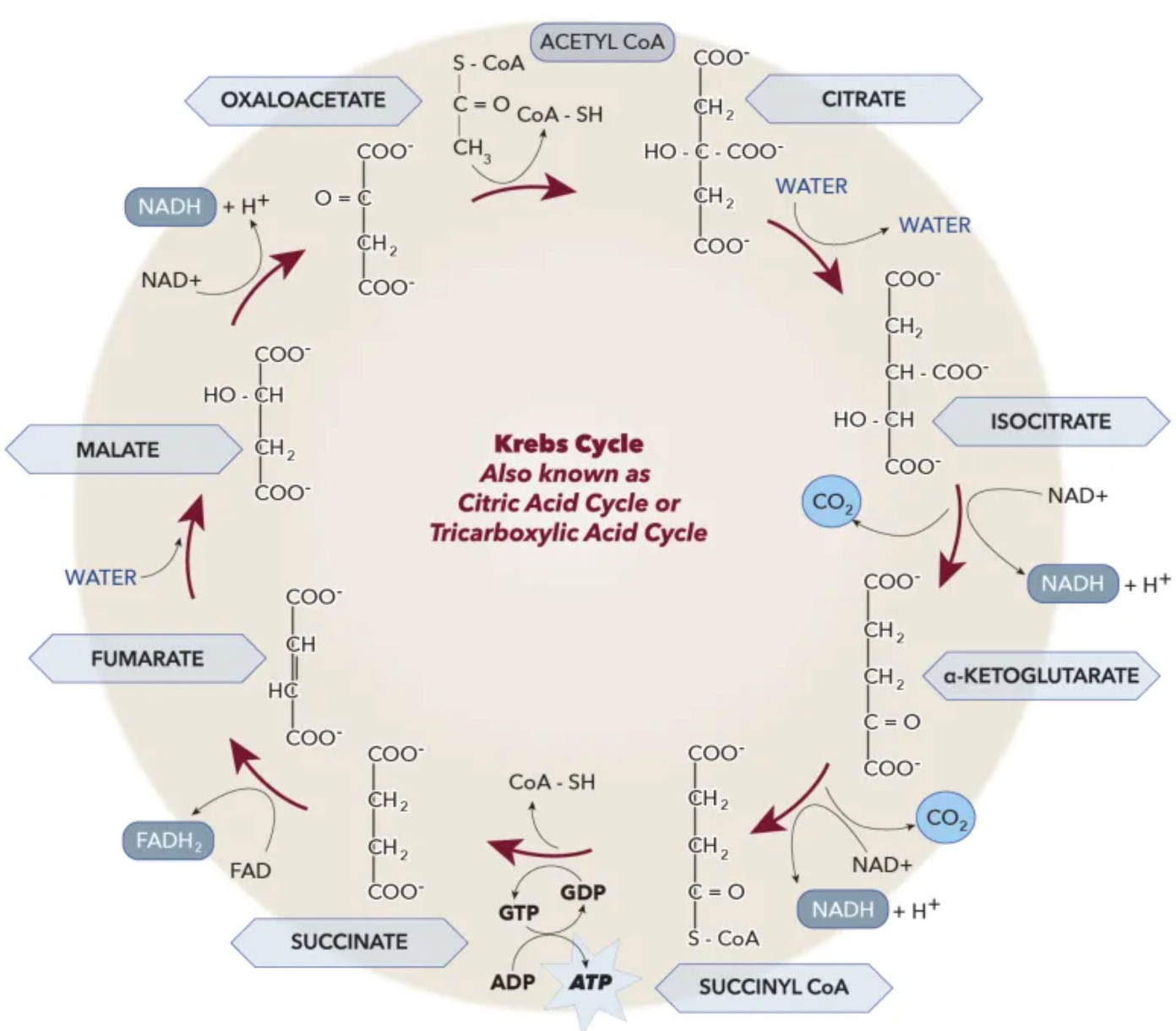
First of all, our bodies are not machines, like cars, where you put in fuel and it gets consumed. Our bodies process our food, breaking it down into individual molecules, atoms and electrons. We use these components to create our “jet fuel,” adenosine triphosphate, ATP, C10H16N5O13P3. We reduce that to adenosine diphosphate, ADP, C10H15N5O11P2. The literature says we burn up our own bodyweight in ATP daily, which is absurd. That would require eating far more than your bodyweight in food and you’d never get off the toilet. What we do daily and moment by moment, is “break off” a phosphoryl radical (HPO2) reducing ATP to ADP. That breaking of the molecular bond generates energy, in a manner only slightly dissimilar to nuclear fission. The resulting ADP and the radical are then rejoined in a process called the Krebs Cycle and it occurs millions of times each second.
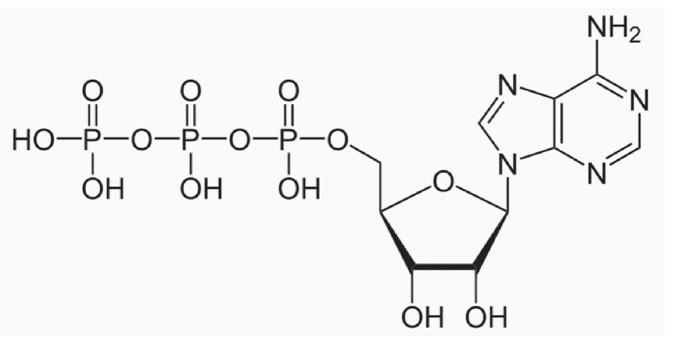
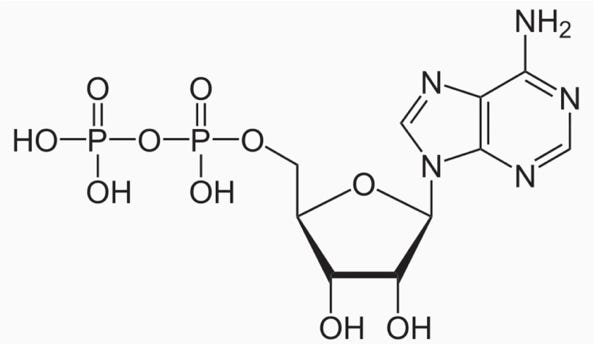
ATP ADP
You didn’t need to know that, and I’ve simplified it to something my professors would sneer at, but it helps to understand that we don’t actually “burn” fat, protein, and carbohydrates. Instead, we process these molecules in an amazingly complex and sophisticated way. You don’t need to know the specifics of how your car’s engine creates driving power in order to drive, and you don’t need to understand the Kreb’s Cycle to lose weight. But what I want you to understand is that our bodies, unlike our cars, can increase their “gas mileage” by as much as 100% or even more under dire circumstances. In bygone days, there were often periods where little to no food was available and our bodies found a way to carry on. This ability is still with us, and it is the monkey in the wrench, as Bruce Willis might say, when it comes to weight loss.
Here’s what the Kreb’s Cycle looks like in scientific detail. And with that I’ll get to the mechanics of how to make it all work. First, I’ll explain what we need to do, and then I’ll tell you why it isn’t ultimately as difficult nor as frightening as it might sound at first blush.
Your body wants a certain number of calories in order function optimally. If it does not get that many, it has three options. First, it can generate more fuel by breaking down glycogen, which is how our bodies store extra sugar in a form readily convertible to glucose, or we can process stored fat into ketones or glucose. Both of these generate weight loss but are challenging for most Americans because our diet has made our internal motors lazy. And, after a few weeks of insufficient intake, a primordial process inside us begins believing there is a famine in the land and initiates the process of detuning our engine, reducing horsepower and conserving fuel. Our bodies shut down processes not needed for today, but which will ultimately be needed for our long-term survival. In this way, our basal metabolism can be reduced by as much 50% and even more in extreme cases. So (for example) the chart says your BMR (Basal Metabolic Rate) should be 1400 calories, but it has somehow degraded to 700, and now you’re gaining weight on the same 1000 calorie-a-day diet that helped you lose 25 of the 75 pounds you wanted to shed. BMR is the number of calories that you theoretically need to survive if you never get out of bed. Normal activity will increase this by 200-300 calories depending on your size and “normal” activities. And exercise calories increase it further. Calculations below do not take exercise into account; I’ll leave that math to you.
Before long, you get so exasperated that you throw in the towel and begin eating like a starving orphan, devouring everything in sight. Soon you have regained 40 of the 25 pounds you lost. A few rounds of this and people give up and just decide to live with being obese. So here’s the secret, in case you haven’t figured it out.
You need to reduce amalgamated calories, just not daily calories, and not by any specific formulaic model. In order to drop a pound a week, you need to eat 3500 fewer calories than you use. But it can’t be accomplished by reducing 500 calories every day, or you’ll hit that same old roadblock. Method one is to reduce by 3700-4000 calories in six days and then consume 200-500 extra calories on day seven. That’s six days of “dieting” and one day of overeating slightly. This can be accomplished by eating nothing one day (1700 calorie deficit for argument’s sake) then perhaps deficits of 300, 700, 400, 250 and 150, followed by your “easy” day consuming 200-500 extra calories. Any math will work, including a six-day deficit 5000 calories (leading up to Thanksgiving) followed by a day of Roman-orgy-style gorging on 1500 extra calories.
I know of people who like to eat and hate to push themselves away hungry who solve the equation by eating every other day, with four days of excess and three days of zero. How you do it will be your choice. And you’re thinking, “How can anyone just not eat three days out of the week? And here’s where I give you the secrets and the method of deploying them.
If you’re someone who can’t imagine a day without eating, or even skipping breakfast, you have two problems, either or both. Your diet has too much sugar and/or starchy carbohydrates, or you are likely type 2 diabetic, but your doctor hasn’t diagnosed it yet because he or she uses the HbA1c test which is less reliable than a 1941 Nash. The proper test for diabetes is the HOMA-IR test, and I’ll tell you about that later. Your insulin processing mechanism is out of balance and it’s likely due to eating too often, even if you eschew sugar and alcohol. Diabetes also results from consuming seed oils, all the cooking oils that didn’t exist 200 years ago.
While type 1 diabetes is a condition where your pancreas creates no or insufficient insulin. Type 2 results from an oversupply of insulin over a sustained period. Insulin is produced by your pancreas in response to eating, and sometimes even smelling food. Olfactory sensation is integral to taste, and your brain can signal your pancreas without any actual eating, especially if you’re a food junkie. While excessive sugars and starches will generate more insulin, any meal will switch on its production. When insulin is consistently oversupplied, insulin receptors begin shutting down to protect from the overload and prevent hypoglycemia, which then causes the oversupply to become systemic. This can and surely will happen if you eat often, even if your total caloric intake is not excessive, and almost irrespective of what you eat. Here’s a graphic showing how it would be in a three-meals-a-day model v six meals, and with two, one or zero daily feedings, the cycle is even more striking. The result should be that circulating insulin drops significantly overnight, allowing for fat to be utilized v stored. But “normal” function literally depends on daily periods of fasting.
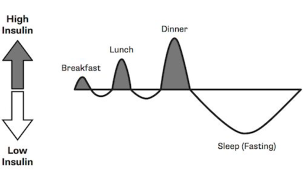
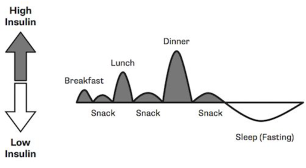
Insulin has two duties, channeling fuel into muscles, and channeling excess into fat storage. High circulating insulin prevents fat from coming out of storage to be utilized. Thus type 2 diabetics have significant difficulty burning fat. Reducing the number of daily feedings, as well as extended fasting, can return this condition to normal. Remember, 200 years ago, virtually no one, other than royalty, ate more than twice in a day. Thus even three meals a day is excessive and the absolute idiots who suggest six or more feedings allegedly to “stabilize” blood sugar are theorizing once again (like they do with calories) that ourbodies are machines rather than biological organisms. The chemistry of human physiology is a collection of cycles; nothing is meant to be static! Fasted insulin should optimally be in the range of 2-5 µIU/mL for best metabolic function and longevity, although the AMA says up to 18 is just fine. They’re wrong. The traditional HbA1c gives you a 90-day average for a hormone that should cycle as high as 135 µIU/mL after eating but should drop to 15 or lower in two hours, and 2-5 overnight.
If you want your fasted insulin tested, you need to vociferously insist on it, because most physicians are virtually married to the A1c test and think it’s the gold standard. Once you have both your fasted insulin and fasted glucose readings, you can find a number of HOMA-IR calculators on line or do your own math with the formula (Fasted Insulin [µU/mL] × Fasted Glucose [mg/dL]) ÷ 405. The safe resulting number for that test should be <2.0 and ideally 1.0-1.5. Anything above 2.0 is borderline or pre-diabetes, and it is possible to be severely diabetic with a reading of 6.0 or above and still have a “normal” A1c reading.
Supplements that can help with insulin regulation are Alpha Lipoic Acid (ALA) Chromium, Cinnamon, Green tea, and Magnesium. Doctors may prescribe something, but I recommend using natural methods. I’ve also heard of doctors prescribing insulin supplementation, which is pure quackery.
Bottom line, once your insulin regulation is normalized, your body should not experience severe hunger or periods of hypoglycemia and will now respond to intermittent caloric restriction (average caloric deficits over time with periodic caloric surplus) leading to weight loss that should be consistent and somewhat predictable, with the caveat that female hormones can often complicate and slow the process. So for many women, this is a tougher slog than for men. Sorry girls, I know it isn’t fair. I’ll mention it to God when I see Him.
Further to the point, if you’re used to eating more than twice a day, step one is to reduce to two meals, although the occasional third meal, perhaps on your “big” eating day is fine. Once you get used to two meals a day, try a day here and there with only one, then a day with none. If it’s a busy day, you may not even notice it. Finally, true multi-day fasting is easier than you think, because the peak of hunger generally hits at around 36 hours. SO… if you eat a significant consisting of zero starches, grains or sugar and high in fat with a nice green vegetable, at around noon, that 36 hour marker will occur a little after midnight the following day, while you’re sound asleep. You should awaken feeling normal and not particularly hungry. From there, continuing for several more days is relatively easy, although you might feel some desire for a tasty delicacy. The amount of will power now required to soldier through is insignificant. And the magic that happens on a fast of four days or more is worth the challenge. I covered this in a prior article: Fasting, the Final Frontier
For now here are a few critical steps that you should begin ASAP. These are on the order of what I call umbrella remedies and do not produce magical, overnight results on their own. They simply cause gradual, perhaps unnoticeable, improvement but without them things will likely progress in the wrong direction, and you’ll now find it easier to follow the game plan outlined above:
1- Eat only real food, grass fed or pastured meat and eggs, organic produce, raw dairy, nothing artificial, and NO PROCESSED FOODS, of any kind, period!! This may be difficult in small towns (but possible in Phoenix, LV, LA, SF...) just do your best.
2- ZERO artificial sweeteners and table sugar IS artificial. Three acceptable sweeteners are:
Honey: (preferably from Beekeepers Naturals which is European sourced. EVERY hive in the US is compromised by glyphosate/RoundUp because RoundUp usage was ubiquitous in the states.
Glycine: or tri-methyl glycine (TMG) an amino acid that is both sweet and protective against glyphosate due to a molecular similarity, and
Molasses
Eating only “real food” is best summed up by the advice I got from fitness icon, Jack LaLanne: If it wasn’t food 200 years ago, it isn’t food today. And know this, when you eat real food, without sweeteners, artificial flavoring and other enhancers, your tastebuds will begin to like the real stuff and you may well find that if you fall back to something like a soda or a donut, you won’t like it as much as you used to or perhaps not at all.
Following is an excerpt from a recent article by natural health pioneer Dr. Joe Mercola:
· Nearly 90% of U.S. health care spending now goes toward chronic disease, much of it driven by dietary guidance that favored processed foods over real, nourishing meals
· The new Dietary Guidelines for Americans [courtesy of new HHS Sec Kennedy] reverse decades of low-fat advice and no longer treat saturated fats from whole foods as dietary threats
· Highly processed foods and added sugars are now explicitly identified as harmful because they disrupt appetite control, energy balance, and long-term metabolic health
· Excess linoleic acid (LA) from seed oils damages mitochondria, and keeping intake under 3 grams per day supports brain function, energy production and overall resilience
· Building meals around real protein, natural fats, and personalized portions restores appetite regulation and gives you lasting control over your health
So you did everything you were supposed to do, followed the “experts” without knowing they were wrong, and now your health is suffering. The good news is that all of it can change and you can start doing it the right way today!!